Debra Lott | Unmasked
Note on Debra Lott, Unmasked by John Hughes
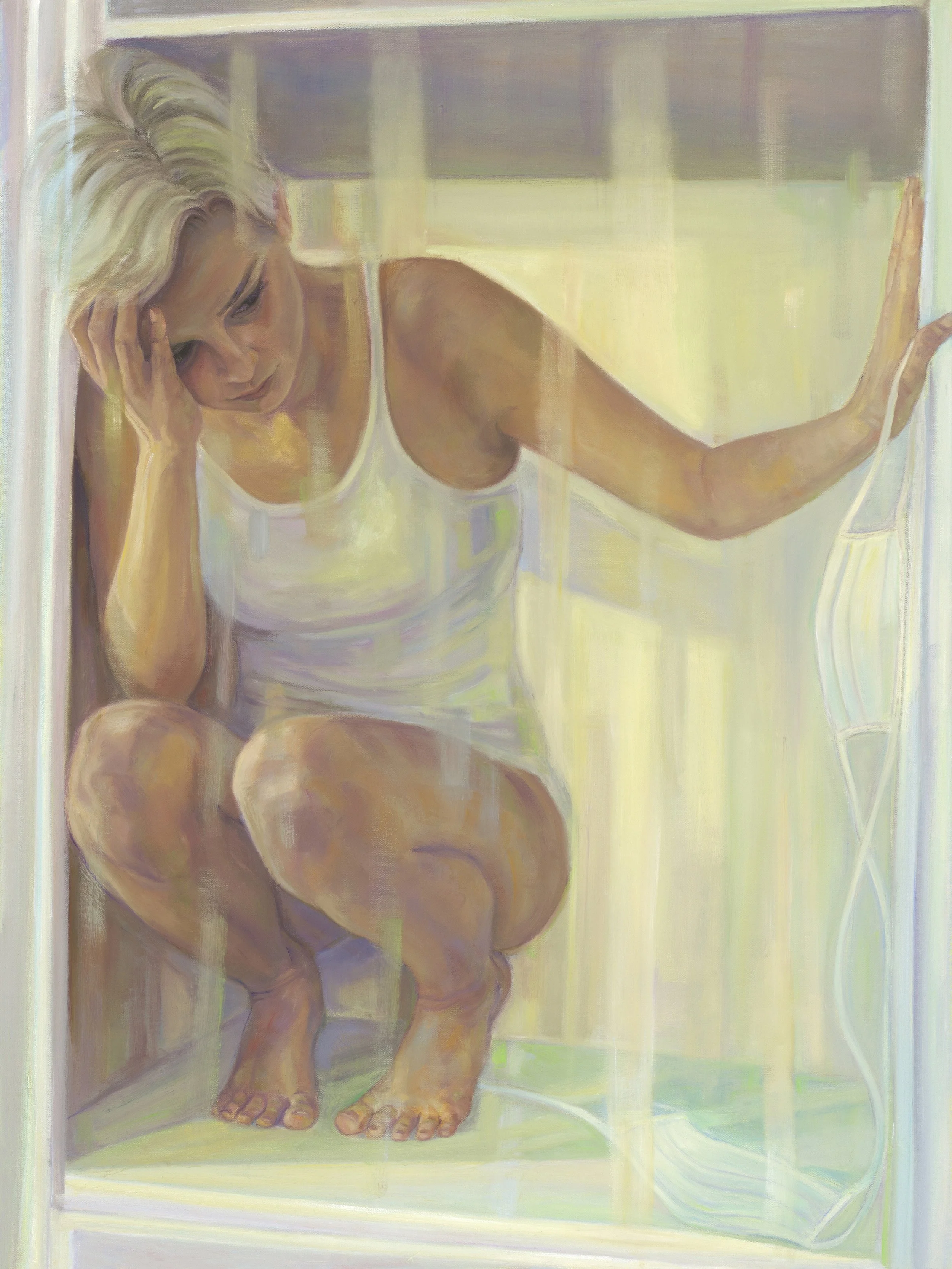
The painting through its representational accuracy immediately transports one to the scene of domestic normality but also a fraught intimacy as if of the bathtub, the shower area, the shower curtain, some sort of private domestic interior. We sense how everyone has been there: it is relatable in that way.
The face of the presented figure is pensive, even melancholic; fraught with the weight of the world, in this sense it’s realistic. At the same time, the expression, slightly averted down, is indeterminate. The sadness-sense in the facial expression could just be an accidental artifact – or the person might really be concerned, if not sad. In this manner the expression of the figure in the painting invites various narratives but does not impose one on the viewer.
We look again, and struggle to place the scene – where is the figure? Is it a curtain in a windowsill, this filmy presence past the figure? Or a diaphanous curtain across a floor? Or merely diaphanous imagery in a painting, an uncanny surface related to the title of the painting, “Unmasked”?
In this sense the image becomes cleverly surreal. If one looks carefully, one notices that the diaphanous veil or curtain breaks into two, one which appears to go behind the figure, while another goes in front of her. But it is hard to tell. There is an elegance of indeterminacy in the image to accompany its figurative precision.
In this manner the painting is indeterminate. At the same time, the description of the human figure by the painting is elegant and precise, but the expression of the figure continues to make one circle back to the thought: the curtain here is see-through. She is vulnerable, in a crouching-esque position. It is as if, in some manner, against her will, or against her comfort, she has been “unmasked.” This creates a drama in the painting.
All of this is possible due to the diligence of the representational accuracy of the painstaking work with the oil paints.
The painting declines to let the viewer settle into a single mode of seeing. It keeps sliding between intimacy, ambiguity, and constructedness. There is exposure without spectacle. We see how non-theatrical the figure’s vulnerability is. This is expressed through physical gesture. The figure is compressed, almost folded into herself. The pose is protective rather than display-oriented. The gaze is downward, self-contained, not outward. Unmasking is related here to a sensation of being seen in a moment that was not meant for viewing. This creates a quiet tension, as you feel like you’ve entered something already in progress, that was not staged for you.
Here, the veil acts as an unstable boundary. When the curtain splits, part in front, part behind, it creates a visual paradox, and mimetically enacts how any veil both reveals and obstructs; is both material and immaterial at once; both behaves like fabric and moves like purely painterly atmosphere. The question might be: is the figure unmasked to be within the painting’s own surface?