Aki Kano | Illumination
Note written by John Hughes for Moments of Gesture.
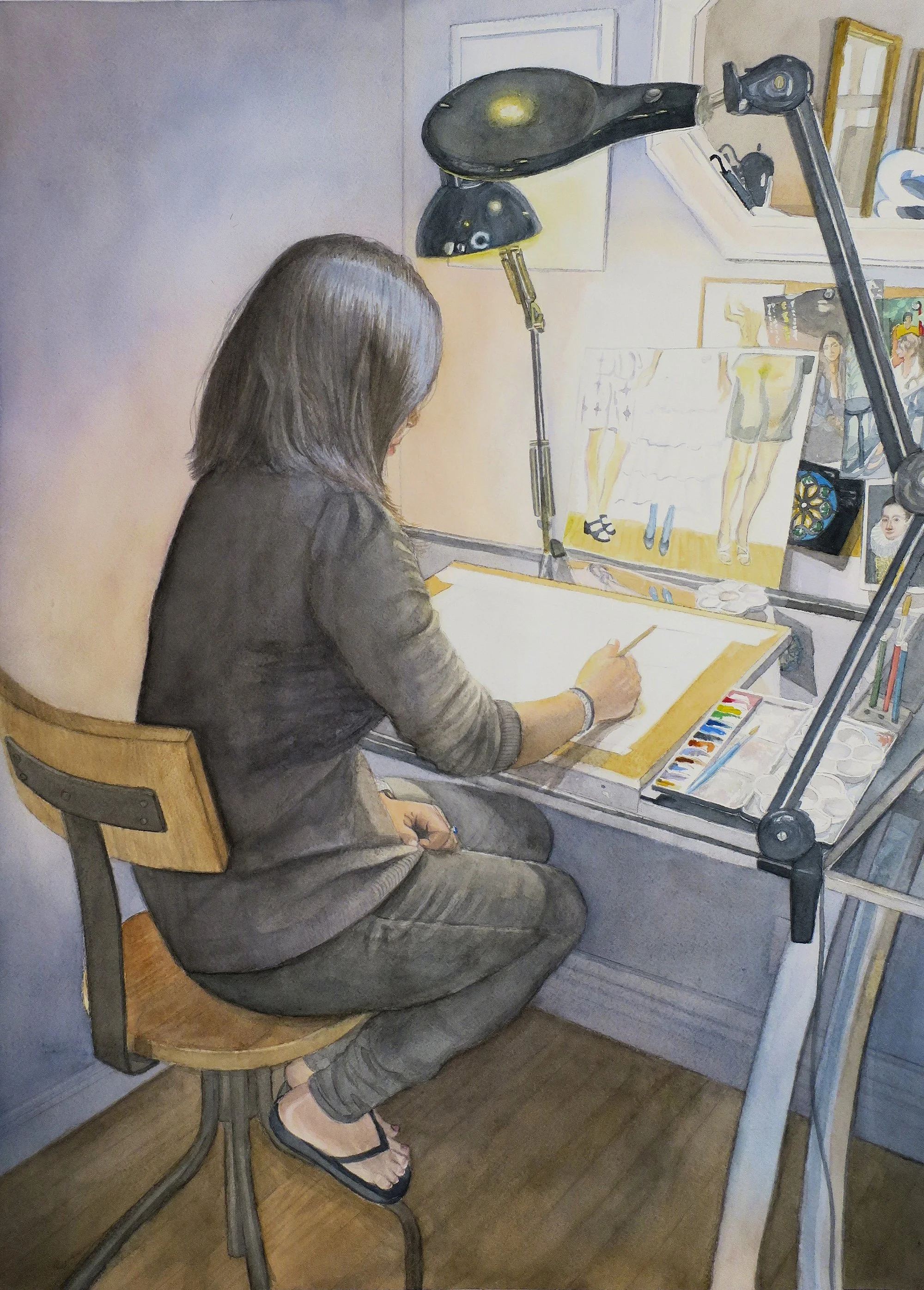
What does this painting show us? It shows us the primal site of the actual artist in action, and yet, at the same time, it is purely fiction, it is imaginary, an image from a dream. Intentional application of pigment to paper has concocted an image, suspended, of a painter, in her workshop, at her task. Nothing too dramatic; she has on flip-flops. This makes it existential. It makes us remember our own actual selves in our regular days; notice the way that the chair, the lamps, are generic. This is not idealized in this sense. But in another sense, it is highly idealized – it is an image frozen in time, held in a luxury of suspension for your inspection. Doubly self-referential, notice on the wall attached are drawings of what could also be partial bodily self-portraits. The light, soft and luminous, such as it is, in this real world, is adequate, the painting seems to say; at least this much is possible. The painstaking authentic accuracy of the figurative description in the style is received by the viewer as an immediate opportunity to momentarily lose themselves in the suspension of reality caused by the mimesis.
In this manner, what the image gives us is not simply an impression of an artist at work, but of the lesson of a constructed origin. One could say, it is a scene that pretends to show us where art comes from, while quietly revealing that this origin is itself made. The painting shows us an image of someone painting. In this sense, it feels like the primal site of creation. But it is entirely fabricated through the same act it depicts. But is “just” tinted water applied to paper.
One could say that the painting becomes a loop: a painting of a painter painting, that produces the illusion of a real painter painting….. But hedging against the vertigo of this recursiveness is imagery of the ordinary as an existential anchor. E.g., the flip-flops. That detail quietly breaks any myth of the artist as elevated or heroic. The chair is utilitarian. The lamp is adjustable, quasi-industrial. The posture is workmanlike, not romantic. The implied gaze is refreshingly uninflected. This grounds the image in what we might call continuity of labor—art as something done in the same world where people sit, shift, adjust, continue.
Here, the representational accuracy is absorptive. The painting creates a believable space, and by entering that space, for a brief time, the viewer may forget the constructedness, the mediation of the painting, even their own position outside it. By offering us a stable scene, held inside an unstable reality, the artwork offers a kind of reassurance that after all, there is a place where attention gathers -- where the hand meets the surface, where something can be made -- even if that place only exists fully inside the image itself.