Elena Caravela | Conceal/Expose
Note on Elena Caravela, Conceal/Expose by John Hughes
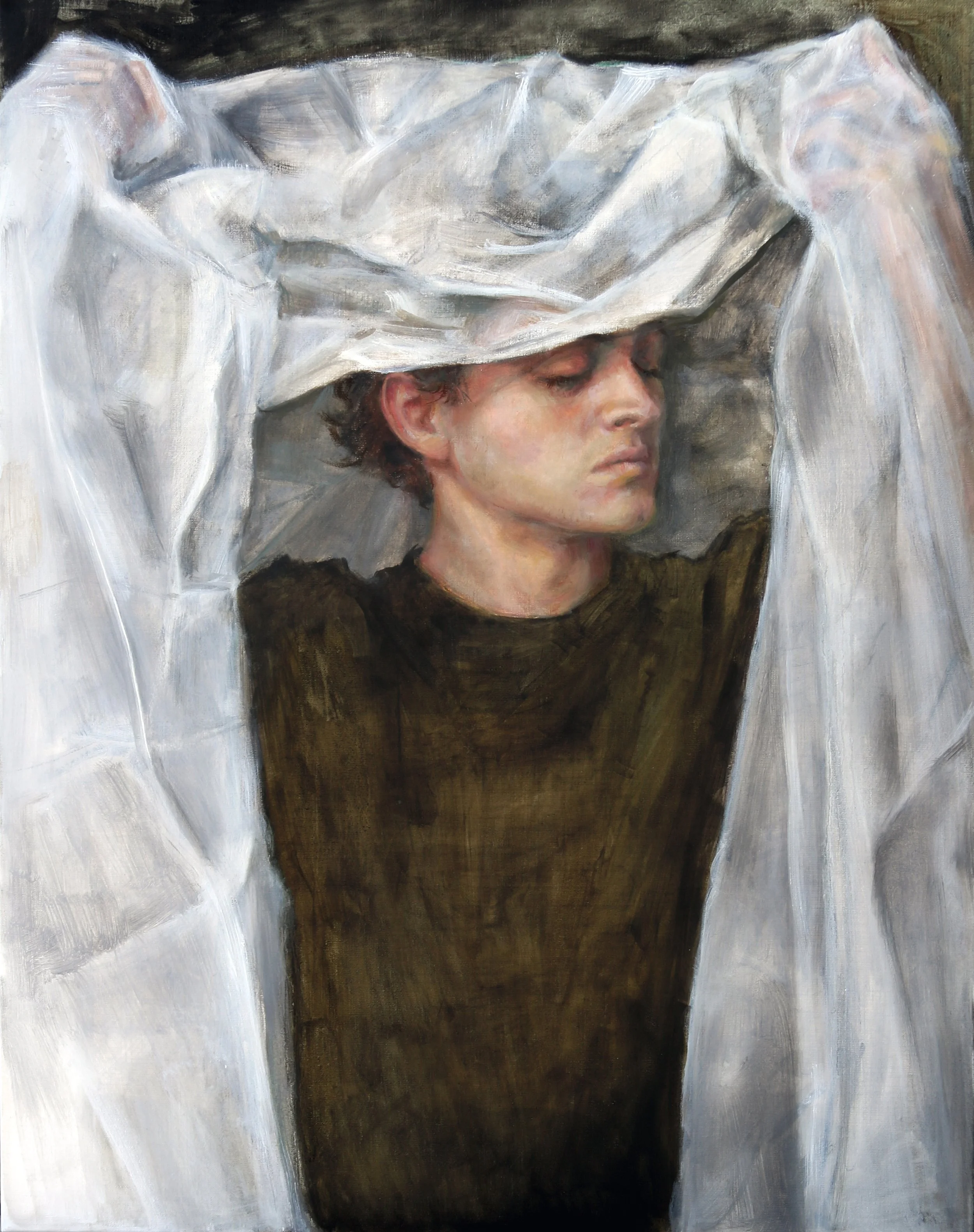
Once again we see an indeterminately melancholic or thoughtful expression. Because of the accuracy of the figurative, representational brush-stroke of the painting, what we see is a male figure, notably with eyes closed, an expression which connotes sleep, dreaming, death, trance, blindness, also meditation. The figure is holding drapery, white sheet, again with a mimesis as if we were looking from above and he was in bed sleeping; there is also an echo or an inflection of an assumption, a figure up in the clouds, the white sheet as clouds. Also, the sheet as funeral shrouds, again the eyes-closed being interpretable either as dreaming, sleep, or death. All of these competing interpretations are elucidated forth via a minimal, Rothko-like presentation of earthtone colors. While the brushstrokes disappear into the created image, they also assert themselves over the surface of the image, and so, it can be glimpsed “only” as brushstrokes or “only” as image – the organic analog matter of the paint plays with the gaze of the viewer, allowing it to proceed along a range between pigment and photorealism. The figure is always about to open his eyes; the paint is always about to dissolve into the image.
In that sense, what the painting presents is not simply a figure in a moment of repose or introspection, but a figure in a moment of gesture -- actively holding himself at a threshold between concealment and revelation. Unlike a passive veiling, the raised arms suggest an effortful suspension. Viewed in this way, the cloth is not falling, not removed, but maintained in a state of openness that never resolves into full exposure. The closed eyes withdraw the possibility of reciprocal recognition, yet at the same time, the figure remains visible. The image offers an intimacy that is simultaneously denied. The white drapery wavers between interpretations as bed sheet, cloud, shroud, and curtain, each metaphor activated but none allowed to dominate; while the figure holds them aloft, these meanings are allowed to coexist rather than settle.
Spatially, the horizontal suggestion of sleep meets the vertical insistence of standing, enhancing a sense of suspension between states of waking and dreaming, emergence and dissolution. The brushwork resonates between coherence and breakdown, allowing the viewer to perceive the image either more as a unified figure or more as strokes of pigment. The restrained, earth-toned palette avoids dramatic cues, sustaining a quiet ambiguity. What the painting ultimately offers is not a fixed meaning but a sustained encounter with a moment just before determination, where the eyes might open, the veil might fall, and the image might either fully resolve or dissolve back into paint. Its gestural ambiguity is a moment of gesture. It conceals as it exposes.